KIPAC Fellow · Stanford / SLAC
Who isEricMoseley?
I am a numerical astrophysicist focused on accurate modeling of the interstellar medium on high performance computers. My specialty is particle-in-cell methods, but I also have expertise in non-ideal MHD, cosmic ray transport, and other myriad ISM physics.
00 Cover
Bio.
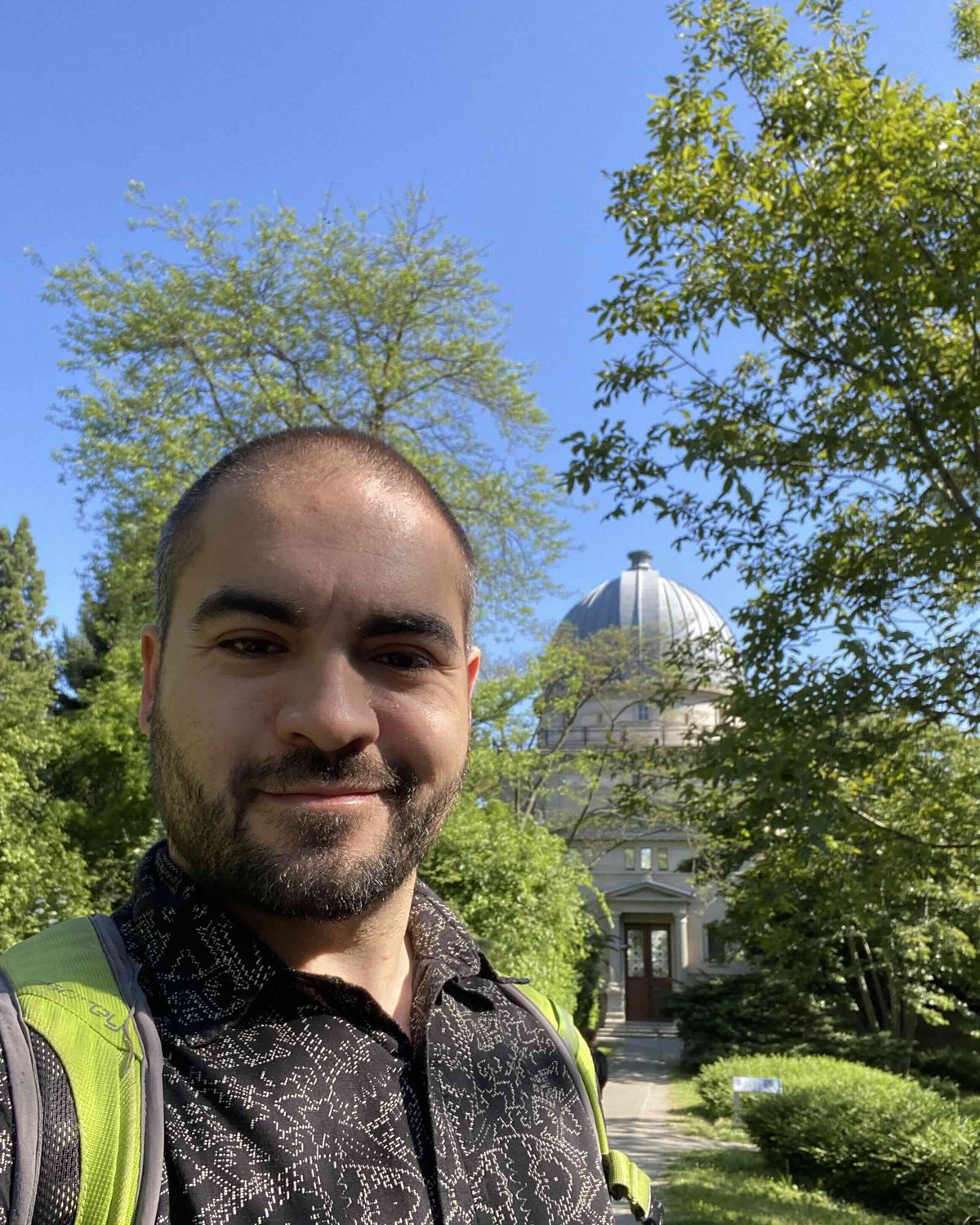
| Now | KIPAC Fellow, Stanford / SLAC (2024–) |
|---|---|
| PhD | Astrophysics, Princeton, 2024 |
| MA | Astrophysics, Princeton, 2020 |
| BS | Astrophysics, Caltech, 2018 |
| Worked with | Romain Teyssier, Bruce T. Draine, James M. Stone, Kengo Tomida, Tom Abel, Susan E. Clark, Jonathan Squire, Philip F. Hopkins, Evan N. Kirby, Jesus Zavala-Franco, Matthew Sampson, Ben Y. Israeli |
| Codes | RAMSES · RAMSES II · GIZMO · Athena++ · Dedalus · phrike |
| Languages | Python · Fortran / CUDA Fortran · Mathematica · C/C++ |
| Taught | AST 204, AST 206 (Princeton) · Ay 1 (Caltech) · Princeton Prison Teaching Initiative |
I was born in Rock Springs, WY. When I was four, I moved to Wenatchee, WA, and that was where I mainly grew up, graduating from Wenatchee High School in 2013. After that, I spent a year in Iceland as a volunteer at a film school and a preschool. From 2014–2018, I was a Caltech undergraduate studying astrophysics. Then, 2018–2024, I was a graduate student in the Department of Astrophysical Sciences at Princeton, where I did my PhD work with Romain Teyssier (original author of the RAMSES code). After graduating, I began my current position at Stanford as a KIPAC Fellow at the Kavli Institute for Particle Astrophysics and Cosmology.
I was interested in science from a young age. Basically as soon as I learned what the Discovery Channel was, I was hooked. From about the age of twelve onwards, I wanted to be an astrophysicist, and an astrophysicist I became.
- Numerical methods
- Dust–gas dynamics
- Non-ideal MHD
- Interstellar chemistry
- Magnetic field structure
- Cosmic ray transport
01 Dust
Dust in turbulent gas
I study how interstellar dust moves through magnetized gas, and how that motion changes where grains collect and collide.
I developed particle-in-cell methods in RAMSES that follow charged grains under drag and magnetic forces, including their feedback on the gas. My papers examine dust acceleration in turbulence and the distribution of dust–gas drift velocities.
I am now working on guiding-center methods for strongly magnetized grains and on GPU implementations for larger simulations.
Methods and turbulent acceleration · Drift velocity distributions
02 Interstellar gas
Turbulence, fields, and chemistry
The interstellar medium contains both warm and cold gas. I study how turbulence and magnetic fields affect its temperature, chemistry, and structure.
My work with Bruce Draine, Kengo Tomida, and Jim Stone connects turbulent dissipation to CH⁺ abundances, H₂ emission, and dust polarization in the cold neutral medium.
Current work brings non-ideal MHD, heating and cooling, and chemistry into simulations of this gas. I also collaborate on cosmic-ray transport and its coupling to turbulence.
03 Methods
Numerical methods for astrophysics
I develop numerical methods for astrophysical fluids and particles, with much of my recent work in CUDA Fortran.
I contribute to the RAMSES II code, and have been one of its top contributors. My work includes charged dust, magnetohydrodynamics, and the tests needed to check these implementations.
I also develop Lagrangian tracer methods. With Romain Teyssier and Tom Abel, I introduced Itô tracers: particles designed to follow a fluid while accounting for the numerical diffusion of the underlying solver.
04 phrike
phrike
A Python pseudo-spectral code for compressible hydrodynamics and magnetohydrodynamics.
I use phrike to explore numerical methods in periodic boxes. It supports NumPy and PyTorch backends for CPU and GPU runs, with examples including Kelvin–Helmholtz instability, Alfvén waves, and the Orszag–Tang vortex.
The source, installation instructions, and example problems are on GitHub.
05 Papers
Publications
First-author publications
- 2026 Itô tracers: continuous-trajectory Lagrangian particles for Eulerian hydrodynamics
- 2025 Dust dynamics in RAMSES — II. Equilibrium drift velocity distributions of charged dust grains
- 2023 Dust dynamics in RAMSES — I. Methods and turbulent acceleration
- 2021 Turbulent dissipation, CH⁺ abundance, H₂ line luminosities, and polarization in the cold neutral medium
- 2019 Non-linear evolution of instabilities between dust and sound waves
Co-authored publications
- 2026 Non-linear saturation of the acoustic resonant drag instability
- 2026 Cosmic-Ray and Plasma Coupling for Isothermal Supersonic Turbulence in the Magnetized Interstellar Medium
- 2026 RAMSES-GPU: Cell-by-Cell Adaptive Mesh Refinement with Magneto-Hydrodynamics and Self-Gravity on Graphics Processing Units
In preparation
A stochastic, guiding-center method for highly charged dust in the interstellar medium.
Moseley, Teyssier & Clark.
Recent talks and conferences
- Interstellar Institute 8 — talk, Sep–Oct 2026
- RAMSES User Meeting — talk, Apr 2026
- The Dusty Universe: Fifth Pan Dust Conference — poster, Nov 2025
Full list in my CV (PDF).
06 Outside research
Outside research
I lift weights, skateboard, and grow cacti and succulents.
Some photos from powerlifting competitions.
07 Contact
08 Play / the gas behind the page
The background simulation
Change the gas, magnetic field, dust, and display settings in the simulation behind this page.
Drag across the background to stir the gas. Use Freeze to pause it, or Reset to defaults to start over.
Controls arrive with the simulation.
Settings are saved for this browser tab. Some controls restart the simulation.
09 Notes
Notes
Short notes on simulations and numerical methods.
Loading notes…